

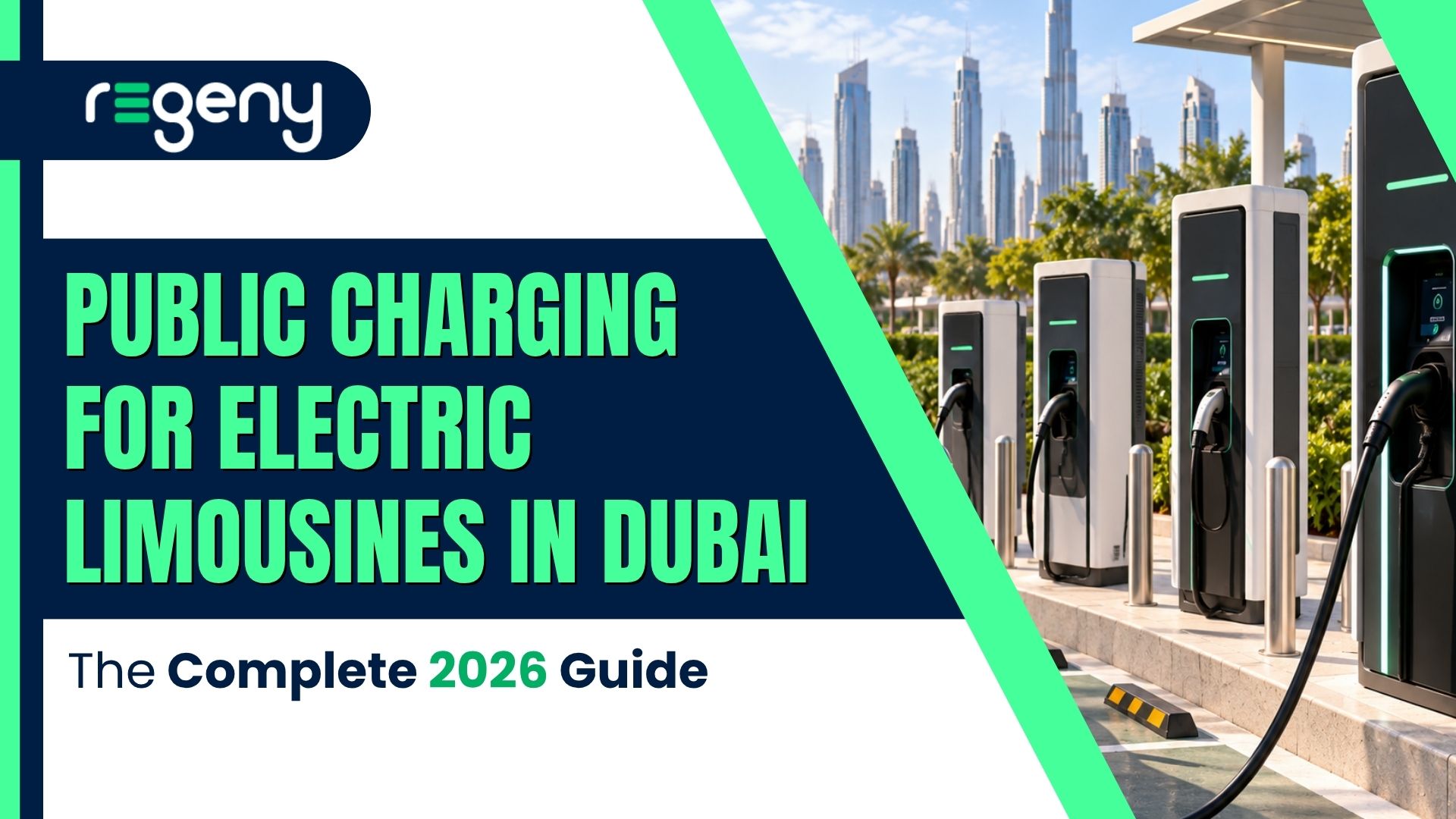
Public Charging for Electric Limousines in Dubai: The Complete 2026 Guide
The first few bookings usually go as planned.
An airport pickup, a hotel drop, maybe a client meeting across town.
Then the driver checks the battery. It’s not critical, but it’s lower than expected, and there’s still half the day’s schedule left.
Going back to the depot doesn’t make sense, so the next stop needs to be a charger.
This is a situation more operators are running into as electric limousines become more common across Dubai.
So, let’s look at how public charging for electric limousines works in Dubai and what operators need to know to keep their fleets moving.
Public Charging for Electric Limousine Fleets – What Operators Need to Know in Dubai
The limousine sector in Dubai is mid-transition. The RTA has set a clear target: Dubai’s entire taxi and limousine fleet to be 100% environmentally friendly by 2027. Hybrid, electric, hydrogen – all options are on the table.
But in the luxury segment, electric vehicles are becoming a common sight. The latest Mercedes-Benz EQS has the numbers to impress, with a 122kWh battery, up to 350kW DC charging, and a claimed WLTP range of 926km.
But fleet operators know those figures rarely tell the whole story. A full day of airport runs, city traffic, and constant air conditioning can quickly eat into that range.
That’s why public charging for electric limousines quickly becomes part of the daily routine rather than something operators rely on only in an emergency.
The Battery Reality for Luxury EVs at Dubai Duty
Standard EV thinking: charge overnight, top up during the day if needed.
Limousine thinking: the car rarely stops. Airport to hotel, hotel to meeting, meeting to dinner, dinner to a late pickup. A full overnight charge at the depot takes you far. But not always far enough.
Even though a Mercedes EQS can comfortably cover long distances. But with passengers, luggage, and the AC running, expect around 22 to 25kWh per 100km, or roughly 490 to 550km from a full charge.
For a limousine already doing 300 to 400km a day, that doesn’t leave much room for unexpected trips.
One long intercity run to Abu Dhabi and back, add city transfers on either side, and a mid-shift top-up isn’t optional – it’s planned.
This is why public charging for electric limousines needs a proper strategy, not a “we’ll figure it out” approach.
What Public Charging Infrastructure in Dubai Actually Looks Like
Dubai’s charging network is large and still growing. DEWA operates approximately 1,860 EV Green Charger points across the emirate as of early 2026.
For limousine operators, the relevant infrastructure falls into two types.
AC Chargers (7kW to 22kW)
These are the most common options for public charging for electric limousines, especially at office towers, hotels, malls, and residential buildings. They’re useful for a car that will sit for two to four hours in a parking bay.
The problem for limousine duty is exactly that – the car rarely sits for two to four hours. If you’re running a vehicle on tight back-to-back transfers, a 22kW AC charger adds about 80-90km of range per hour. Useful, not fast.
AC public charging rates in the UAE currently sit at AED 0.70 per kWh plus VAT.
DC Fast Chargers (50kW to 150kW+)
This is where public charging for electric limousines becomes far more practical for fleet operators. A 120kW DC unit can push a vehicle from 10% to 80% in under 50 minutes. At 150kW, that window tightens further.
DC public charging in the UAE is priced at AED 1.20 per kWh plus VAT under Cabinet Resolution No. 81 of 2024. For a 60kWh top-up on an EQS, that’s roughly AED 72-80 per session. Compare that to the cost of a petrol fill, and the economics still significantly favour electric.
Regeny’s DC fast chargers go up to 360kW. At that level, a compatible vehicle adds over 300km of range in approximately 10 minutes. For a limousine operator managing tight schedules, that kind of speed changes what’s possible mid-shift.
Best Locations for Public Charging for Electric Limousines in Dubai
Coverage across the city is uneven. Knowing the right zones matters.
Downtown Dubai and DIFC High-density commercial and hospitality area. Multiple DC charging points across hotel car parks, commercial towers, and public bays. This is the zone where a limousine is most likely to have a genuine window between transfers – 30 to 60 minutes between a hotel drop and the next pickup.
Dubai Marina and JLT Well-served for AC charging. DC options are more limited but present. Good for a longer parking window if the schedule allows.
DXB Airport Zone Fast charging has expanded around the airport corridor. For a car sitting between incoming and outgoing flight pickups, this is a natural opportunity to pull into a fast charger and recover range without breaking the schedule.
Palm Jumeirah and Bluewaters Hotel properties in these areas increasingly carry their own charging infrastructure. If your client is spending some time at the venue, your limousine can recharge while the chauffeur waits. Simple.
Fuel Station Integration ENOC and DEWA have partnered to expand fast charging across service stations. This is useful for a vehicle caught between zones with limited time. A fuel station stop with a 120kW charger is a 25-minute recovery that adds 120-150km. Workable.
How to Plan Public Charging for Electric Limousines Efficiently
Smart fleet operators don’t rely on luck. They build charging into the schedule.
Morning start at the depot – Full charge before the first transfer. This is the baseline. Every vehicle starts the day topped up. Overnight AC charging at AED 0.29 per kWh (residential DEWA rate) is the cheapest energy cost in the operation.
Mid-shift DC top-up – If the day involves 300km+ of active duty, a single mid-shift DC fast charging stop is planned, not reactive. 30 minutes at a Regeny-enabled 120kW station recovers most of what was spent in the morning.
Hotel and venue dwelling – If the limousine is waiting on site at a property with charging infrastructure, it charges passively. The vehicle doesn’t need to idle. It sits on AC power and recovers range at no driver cost.
End-of-day return charge – Vehicle plugs in at the depot on an AC wall box. Ready for the next morning.
This is how electric limousine operations work in cities where the infrastructure is mature. Dubai is close. Not fully there, but close enough that a well-planned schedule works.
The Role of Regeny in the Fleet Charging Picture
Regeny’s managed charging solutions help fleet operators keep their vehicles charged without putting extra strain on the depot’s power supply. When several vehicles return together, they don’t all start charging at once. Regeny manages that automatically and keeps a record of every charging session.
If a driver needs to charge during the day, the Regeny EV Charging App shows nearby stations, available connectors, and whether the charger can comfortably accommodate a larger vehicle.
What This Means for Operators Building a Fleet Now
Public charging for electric limousines in Dubai is viable. The infrastructure is real, growing, and increasingly fast.
But it requires a different operational mindset. Fuel stops were reactive – you charge when it’s low. EV fleet management is proactive. You build charging into the schedule the way you build in travel time.
The operators who are getting this right are the ones pairing strong depot infrastructure (managed home base charging) with a clear strategy for public charging for electric limousines across their operating zones.
The vehicles are ready. Dubai’s charging network is growing. For operators, it’s simply a matter of putting the right charging plan in place.
Ready to Set Up Public Charging for Electric Limousines Across Your Fleet?
Regeny works with limousine operators, fleet managers, and hospitality groups to install managed charging at depots, hotels, and commercial locations across Dubai.